
Published on 23.2.2026
Roma women in Ukraine combine emergency response, human rights advocacy, and community work
As the war in Ukraine continues, the Roma minority has come to face increasingly difficult circumstances in the country. The Deaconess Foundation supports the work carried out by its partner organisation, the Roma Women Fund Chiricli, which combines emergency aid, human rights advocacy, and grassroots community work.
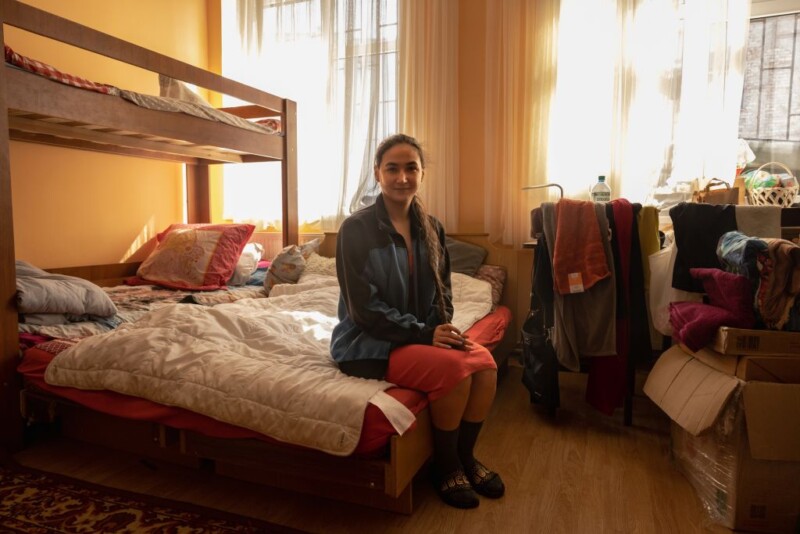
As Ukraine marks four years since Russia launched its full-scale invasion on 24 February 2022, the humanitarian situation of the country’s Roma minority has sharply deteriorated. Throughout 2024–2025, intensified Russian attacks, prolonged displacement, and long-standing systemic exclusion left tens of thousands of Roma without essential identity documents, stable shelter, or reliable access to basic services such as healthcare, education, and social protection.
In the midst of the war, two organisations have been working together since 2018, expanding, significantly expanding their efforts after Russia launched a full-scale invasion in 2022. Since then, the Deaconess Foundation has funded emergency interventions implemented by the Roma Women Fund Chiricli, whose nationwide network of Roma mediators and cooperation with local organisations has played a central role in reaching communities that are often overlooked by mainstream humanitarian actors.
Today, their partnership spans 13 regions, providing emergency aid, legal support, and human rights advocacy at both national and international levels.
Published in the context of the ongoing human rights and humanitarian crisis triggered by Russia’s full-scale invasion of Ukraine, this article highlights the devastating impact on civilians of Russia’s illegal war of aggression. According to the Council of Europe Commissioner for Human Rights, the war continues to generate severe and widespread human rights violations, including persistent attacks on populated areas and critical infrastructure. This has left displaced people and vulnerable communities in acute need of protection.
The United Nations Office for the Coordination of Humanitarian Affairs also emphasises that relentless bombardment, including large-scale drone and missile strikes, has caused the widespread destruction of homes, schools, hospitals, and essential services, resulting in a sharp rise in civilian casualties throughout 2025. Civilians are experiencing severe sleep deprivation and stress.
Escalating attacks and worsening civilian impact
According to United Nations Human Rights Monitoring Mission in Ukraine (HRMMU), 2025 became the deadliest year for civilians since the beginning of the full-scale invasion, with at least 2,514 civilians killed and more than 12,000 injured. Russian forces intensified long-range missile and drone attacks on major cities and industrial targets across Ukraine.
Systematic strikes on energy infrastructure meant that the country was only able to meet around 60% of its electricity demand, triggering rolling blackouts that disrupted heating, water systems, and internet access. The situation became particularly severe for Roma communities, many of whom live in segregated settlements with poor infrastructure.
Healthcare facilities were repeatedly hit. Between May 2024 and December 2025, Ukraine accounted for 910 of the 2,495 global attacks on healthcare facilities recorded by the WHO.
Displacement patterns shift, but vulnerabilities persist
According to United Nations High Commissioner for Refugees, by late 2025, 5.9 million Ukrainians were living abroad as refugees, while 3.7 million remained internally displaced. However, there has been an increasing trend of return movements, including Roma families. Chiricli recorded that around 3,500 Roma had returned to Ukraine, with many reporting discrimination in neighbouring countries, including inequitable access to transport, aid, education, and shelter. Others cited exposure to violence, exploitation and the risk of human trafficking.
Upon returning, most Roma found that their homes had been destroyed or occupied, or were located in active combat zones. Many children remained out of school for extended periods, exacerbating existing educational disparities.
Humanitarian response reached tens of thousands of people
Altogether, the Deaconess Foundation’s 2025 emergency assistance programme – implemented by Chiricli in cooperation with state authorities, particularly with the Ukrainian Parliament Commissioner for Human Rights (Ombudsman) – reached 14,333 unique beneficiaries in 2025 alone. When repeated contacts such as follow-ups, distributions, and outreach activities are included, the total number of interactions exceeds 95,000. Throughout 2024-2025, grassroots initiatives supported by the project reached about 140,000 people.
Key humanitarian results included the following:
- 26,428 people received information and individual consultations about state and municipal humanitarian support, martial law (restrictions for citizens), and possibilities to evacuate or cross borders
- 70,380 people received hot meals or food assistance.
- 15,000 people used heating points supported by Chiricli and partner organisations.
- 4,992 people received firewood and 3,360 received blankets for winter.
- 10760 people received legal and social assistance
- 420 IDPs accessed medical consultations and 735 Roma women and children received psychosocial support
- Shelters in Mukachevo, Beregovo, and Odesa supported hundreds of Roma IDPs with accommodation, meals, legal services, and psychological care.
Emergency assistance was particularly crucial during the winter, when sustained attacks on power grids left entire regions without heat or stable electricity. In several cities, Chiricli collaborated with faith-based organisations to assist people sheltering in heating points or fleeing frontline areas.
Evacuations amid intensified fighting
Intense fighting continued along the eastern and southern frontlines. Chiricli organised the evacuation of 543 Roma from the Zaporizhzhia, Donetsk, Kharkiv, Sumy and Odesa regions.
A major operation took place in Pavlohrad, where thousands of people fleeing the Pokrovsk area passed through a transit centre in mid-2024. Chiricli coordinated with regional administrations to ensure that Roma families were included in official evacuation procedures, addressing earlier patterns of exclusion.
Legal identity remains a critical barrier
According to Chiricli, the lack of identity documents is one of the most severe and persistent issues facing Roma in Ukraine. A significant proportion of the estimated 200,000-400,000 Roma in the country lack passports or birth certificates.
Between May 2024 and December 2025, Chiricli supported 518 people to obtain identity documents, including passports, birth certificates, disability documents and IDP status, in collaboration with the Ukrainian Parliament Commissioner for Human Rights.
In January 2025, the Ombudsman’s Office established a dedicated Roma rights unit, launching joint working groups, monitoring visits, and outreach initiatives to expedite registration procedures. Mobile documentation services and multilingual assistance were expanded in Transcarpathia and other regions.
Strengthening local Roma organisations
Support for Roma civil society increased significantly. In 2024, Chiricli backed 10 local initiatives, reaching at least 1,700 people, and in 2025 it supported an additional four organisations, reaching at least 6,000 people.
Activities included mobile outreach to remote settlements, legal counselling, youth leadership programmes, psychosocial support, community events, and coordination with municipal authorities. These local organisations often worked in areas rarely reached by other humanitarian actors.
National and international advocacy
Chiricli and the Deaconess Foundation intensified their advocacy work between 2024 and 2025. The two organisations held over 30 meetings with international partners and 16 with national authorities, and contributed to the Ukraine Recovery Conferences in Washington and Rome.
Issues raised included identity documentation, discrimination at checkpoints, the inclusion of Roma in reconstruction planning, and the implementation of Ukraine’s national minority strategies. A forthcoming “Mapping of the Social Needs of Roma Communities” in Transcarpathia aims to guide local government responses.
Challenges: security, infrastructure, and discrimination
The major challenges for Roma in Ukraine at the moment include:
- Frequent power cuts, which hamper communication, transportation, and service delivery;
- Rising costs and reduced access to medical services, especially in frontline regions;
- Displacement of Roma mediators and CSO staff due to insecurity;
- Incidents of ethnic profiling at checkpoints in Zaporizhzhia and Toretsk, which have prompted official investigations.
Reconstruction and EU accession: risks and opportunities
As Ukraine progresses in its EU accession negotiations, minority rights, including the treatment of Roma, could become a pivotal factor. Advocates warn that Ukraine must avoid repeating patterns seen in previous EU enlargements where the inclusion of Roma lagged despite strong legal frameworks being in place.
The key priorities identified in the recommendations of humanitarian and rights advocates include:
- Simplifying identity documentation procedures and expanding mobile registration units.
- Training authorities in the prevention of human trafficking and gender-based violence, given the elevated risk faced by undocumented Roma and Roma women and girls.
- Strengthening anti-discrimination enforcement and documenting hate crimes.
- Building the capacity of local authorities to implement Roma inclusion policies.
- Investing in adequate housing for Roma settlements to lay the groundwork for long-term inclusion.
As many Ukrainians are expected to return to different regions than those they fled, national policies to promote peaceful coexistence between Roma and non-Roma communities will also be needed.
Continuing commitment
Despite the escalating humanitarian crisis, the resilience of Roma communities, supported by grassroots work coordinated by Chiricli mediators nationwide, is remarkable. The Deaconess Foundation has stated that the joint efforts to support the most vulnerable Roma families will continue “for as long as needed,” even as Ukraine prepares for reconstruction and EU integration.
“We stand with the people, families and communities that keep showing us that resilience is not just a slogan, it is daily courage, dignity and an unwavering will to protect one another. Our work is not only about delivering aid, but about restoring dignity, rebuilding trust, and ensuring that Roma families and other vulnerable individuals are not left behind in Ukraine’s future. Human rights must guide reconstruction just as much as policy or funding,” says Maria Dorofte, Programme Coordinator responsible for the work in Ukraine at the Deaconess Foundation.
Without this strong intervention, undocumented Roma would remain invisible, the Roma mediators would not exist or be able to act on a sufficient scale; state authorities would lack a minority-focused vision; thousands of Roma IDPs would be left without assistance due to discrimination; and the Ombudsman’s Roma Rights Unit would not have emerged in its current form.
“The strength of our humanitarian work model in Ukraine comes from bringing together humanitarian assistance and human rights advocacy, as well as cooperating with and strengthening the Roma civil society and key institutions such as the Ombudsman and the State Migration Service. This enables us to address urgent crisis needs while contributing to Ukraine’s long-term democratic development,” states Anca Enache, Head of International Affairs at the Deaconess Foundation.
The joint action by the Deaconess Foundation and Chiricli has succeeded in redefining humanitarian action by empowering Roma women to combine and lead grassroots emergency responses, provide human rights leadership and foster inclusive community relations in Ukraine.
Contact us
Maria Dorofte
Program coordinator International work +358504011212 maria.dorofte@diakonissalaitos.fiRead more

- Project
- Research and publications
- Roma
Mentor’s Handbook provides tools for building trust

- International work
- Research and publications
- Roma
- Research and publications
Empowering Roma women through mentorship: insights from Finland’s National Report
- International work
- International work
- Research and publications
- Vaikuttaminen