Aurora – from Stjernvall to Karamzin
Eva Aurora Stjernvall was born in early August 1808 when Finland was part of the Kingdom of Sweden. She died 94 years later in the Grand Duchy of Finland, ruled by the Emperor of Russia. During her life, Aurora married twice, bearing the surnames Demidov and Karamzin.
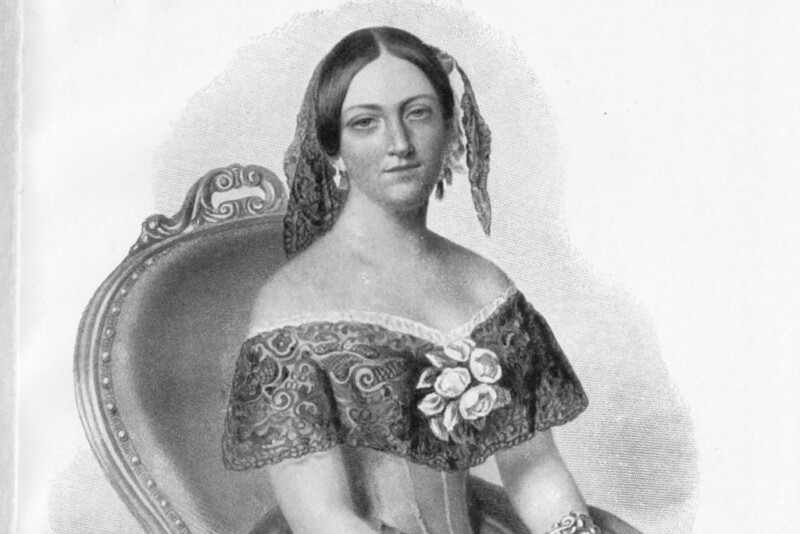
Eva Aurora Stjernvall was born in Pori (Ulvila), in the eastern part of the Kingdom of Sweden, in early August 1808. After her, two more children were born into the family of Lieutenant Colonel Carl Johan and Eva (née von Willebrandt) Stjernvall. At the time of Aurora’s birth, her father Carl was a prisoner of war in the Russian army.
After the war ended, Finland became a Grand Duchy as part of the Russian Empire. Part of Finland was returned as the so-called Old Finland, which had fallen under Russian rule in 1721. As part of the administrative reorganization, the Vyborg province was established and Carl Stjernvall was appointed governor of the province in 1812, when the Stjernvall family moved to Vyborg. Carl Stjernvall died already in 1815. The following year, the widow Eva married the new governor Carl Johan Walleen. At that time, Aurora was sent to Saint Petersburg to be cared for and raised by her Aunt Minette. She lived with her aunt for four years. During that time she learned the French language of the nobility and a fair amount of Russian.
In 1820, the Walleen family moved to Helsinki after Carl Walleen was appointed senator and in 1822 as procurator. His position was high in the state administration, and therefore Walleen was a central figure also in the city’s social circles. These included officials, merchant families, and the city’s Russian officer corps. Aurora was introduced in the social circles, as was customary at the time, at the age of 16. Her sweet demeanor and beauty attracted much admiration. She was introduced to the Russian Emperor Nicholas I herself in 1830. The beautiful Aurora was appointed a lady-in-waiting at the emperor’s palace, at the same time as Emelie, daughter of Carl von Rotkirch, president of the Vaasa Court of Appeal. However, it took six years before the palace doors opened.
Aurora Demidov
Aurora moved to the court as a lady-in-waiting to Empress Alexandra in early 1836. She served as a lady-in-waiting for less than a year, as Aurora married Paul Demidov, one of the richest nobles in Russia, in November 1836. Aurora had refused the prince’s proposal twice, but the third time was the charm; this time the answer was positive, with the support of the imperial couple. The marriage was hoped to keep the noble wealth within Russia. The couple settled in St. Petersburg but spent long periods in Central Europe, often at health spas. There, the ailing Paul Demidov found relief for his ailments. In October 1839 Aurora gave birth to a son, who was baptized after his father as Paul. When the boy was only six months old, Paul Demidov died. Aurora was left with a large fortune, a palace in St. Petersburg, and half of the Demidov industrial enterprises in the Urals, with the other half owned by Paul’s brother Anatole. When Paul came of age, the company was transferred entirely to him.
Widowed Aurora divided her time between Helsinki, the parish of Espoo, and St. Petersburg. In St. Petersburg, she took part in social life and the entertainments of the aristocracy; in Helsinki, besides social life, she spent time in quiet, especially at the Träskända manor in Espoo. She had purchased this beloved place from her stepfather in 1840.
Aurora Karamzin
In 1846 Aurora remarried. The wedding with the Russian colonel Andrei Karamzin was celebrated in Peterhof. Around the same time, Aurora began to think more deeply about the meaning of life and started seeking ways to help suffering people. This was influenced by, among other things, many sudden deaths that occurred within her close circle. Significant was also the time spent together with her spouse in Paris from 1847 to 1848. In France, one could freely express their thoughts and participate in politics – activities that were strictly forbidden by Emperor Nicholas I in Russia. In Paris, the couple became aware of social injustices. Therefore, in the summer of 1849, they traveled to the Urals to personally explore the Demidov mining community. There, a number of social reforms were implemented. The years following the long and arduous journey were mostly spent in quiet family and social life. Winters were spent in St. Petersburg and summers in Helsinki and Espoo’s Träskända.
In the early spring of 1854, a war broke out between Russia and Turkey, known as the Crimean War. Amid widespread patriotic enthusiasm, Andrei Karamzin decided to return to military service. He fell by the Danube in May 1854. When she became a widow for the second time, Aurora was 46 years old. The marriage was childless.
Paul Demidov Jr
Paul’s behavior often caused problems for his mother from an early age. The wealthy heir was more interested in amusements than studies or duties. In 1860, when the boy came of age, Aurora’s share of the Demidov estate was to be transferred to his responsibility. However, the plan was thwarted for several years by Paul’s extravagance and irresponsibility. These caused concern not only for the mother but also for the managers of the company handling the estate. Aurora moved to Paris in 1861 to curb her son; she succeeded, and the entire Demidov estate could be transferred to Paul’s responsibility. But the more responsible period lasted only a few years—the temptations of Paris won out again. And once again, Aurora had to sort out the mess caused by her son. He had managed to lose a significant fortune to gambling and a lavish lifestyle to such an extent that Aurora had to sell the Le Grand Sancy diamond she owned to pay off her son’s gambling debts. Aurora had received this diamond, the world’s seventh-largest, as a wedding gift from her first husband.
For the relief of his mother, Paul married in the spring of 1867. Aurora handed over the responsibility for her son to his wife – now she was free to pursue her own projects. The most important of these was the founding of the Deaconess Foundation in Finland in 1867. Aurora managed to be present at the inauguration ceremony on 17.12.1867, but already at the beginning of 1868 she had to rush again to help and support her son: Paul had become a widower and at the same time a single parent of a small boy, as the young wife Marie died in childbirth. Aurora now settled for several years in Central Europe, visiting Finland mainly in summers. She kept in touch with the Deaconess Foundation by letter. Paul remarried a couple of years later to Princess Héléne Trubeskoin. The union produced five children. Paul Demidov died in 1885. Despite his colorful lifestyle, he is also remembered for his charity work, which partly targeted the Helsinki Deaconess Foundation.
The decades of the late 1800s became a period in Aurora’s life, the most visible result of which is the Helsinki Deaconess Foundation, founded in 1867. The institute held a special place for Aurora until the end of her life. Aurora died on May 13, 1902. During her funeral procession, the deaconesses had the honor of walking immediately after the family members.
The author Jaana af Hällström works as a communications specialist at the Diaconia Institute and specializes in the history of the institute.
Several books about Aurora Karamzin have been used as source material, mainly Aurora Karamzin Aristokraatin elämää, Espoo City Museum.